
The Energy Hype Cycle Is Loud. The Grid Is Not: Clickbait vs. Reality in Energy
Originally posted here
n popular media coverage, energy stories are often influenced as much by headline grabbiness as actual industry movement. The headlines yell at us:
Nuclear is back!
Geothermal is hot!
Coal is killing you!
But how much of these stories are actually rooted in true developments? Grid planners can’t keep the lights on based on what stories happen to be trending.
I’m often surprised when a friend who isn’t in energy reaches out to ask about an exciting-sounding (but not entirely relevant) tech they just read about (Can’t hydrogen solve this all? What about gravitational energy storage?). But it makes sense: Those not entrenched in the daily developments are much more likely to open a push notification on shiny new tech than they are, say, to engage with the fact that a run-of-the-mill gas plant is being built in their state.
To measure this apparent gap between popular media coverage and reality, I’m donning my engineer hat and busting out the energy drink that got me through college statistics classes. Specifically, I decided to compare Google Trends results against plant capacity changes over time (with the help of EIA’s monthly electric generator inventory) for eight key power sources. Does popular attention coincide with the opening and closing of power plants?
What does the data say?
The investigation comes with a lot of variables to map: Eight different power sources over 16 years, tracking a) capacity added, b) capacity closed, and c) relative Google Trend rating for each of those combinations. My fellow data nerds can see the table of exact numbers here. Everyone else can just check out the resultant graph below.
This chart has much to digest, but some compelling trends pop out:
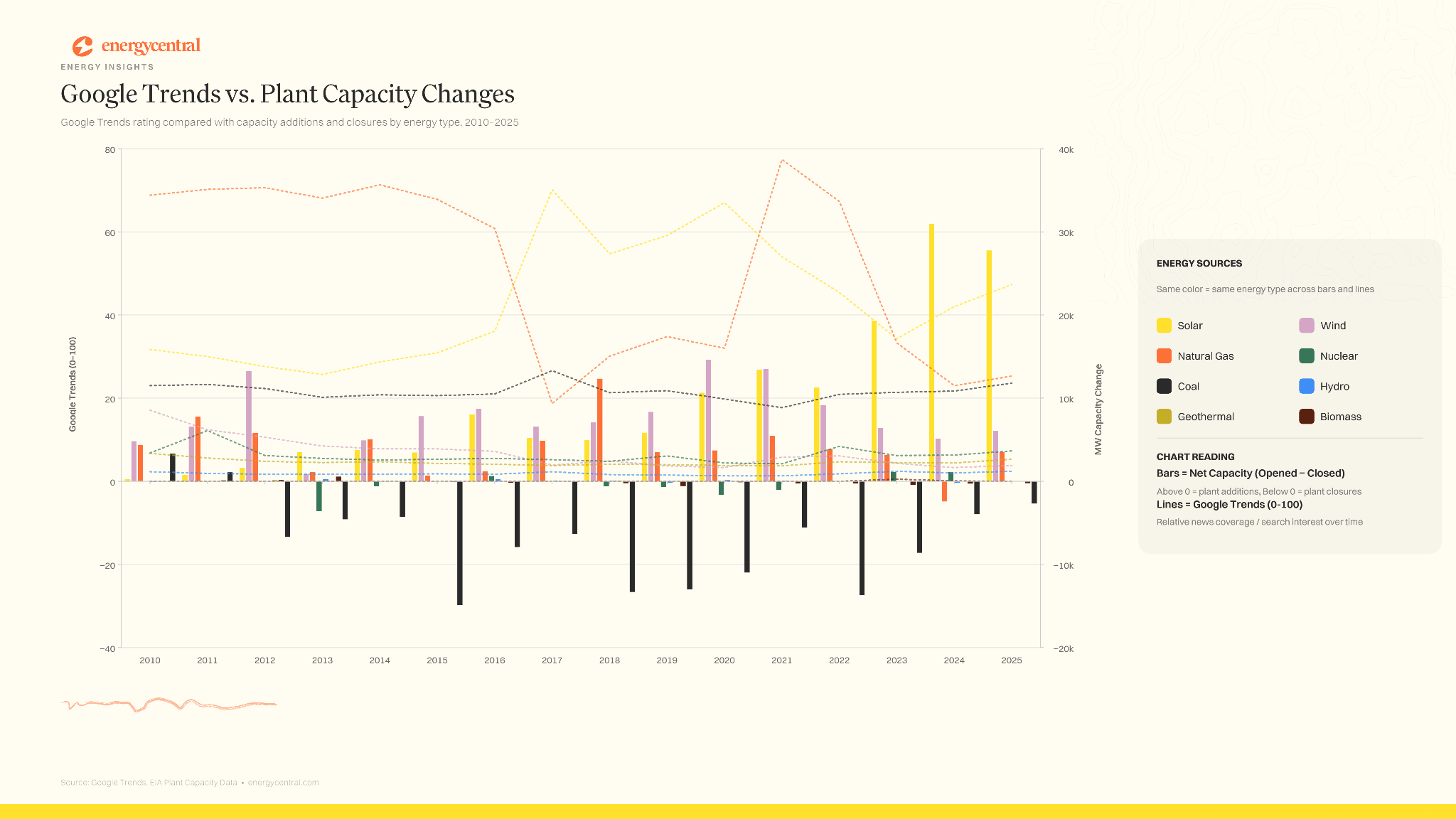
Solar was hyped up for much of the coverage period, but capacity only really ramped up in the latter years.
The 2010s was a huge decade for solar reaching maturity, and that piqued our collective search interest. But these developments didn’t translate to massive installations until the 2020s, once falling costs were boosted by favorable policies.